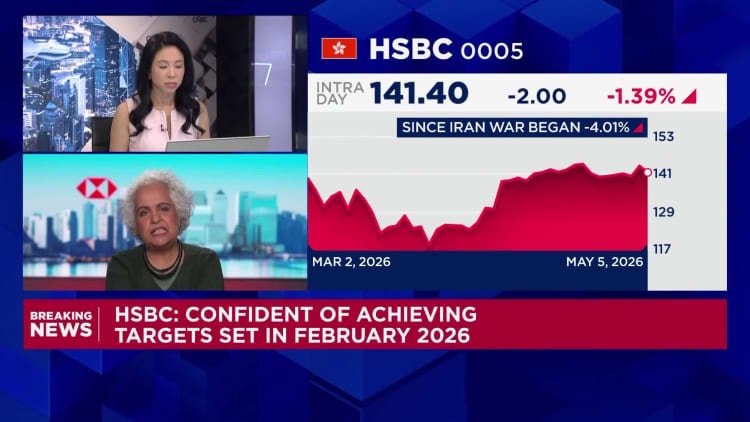
HSBC shares drop as first-quarter pre-tax profit misses estimates on higher expected credit losses

Europe’s largest lender, HSBC, reported first-quarter pre-tax profit of $9.4 billion on Tuesday, missing analysts’ estimates on the back of higher expected credit losses and other impairment charges.
HSBC’s revenue gained 6% year-on-year, exceeding estimates, on stronger wealth fees and other income.
Here are HSBC’s first-quarter results compared with the consensus estimates compiled by the bank.
- Pre-tax profit: $9.37 billion vs. $9.59 billion
- Revenue: $18.62 billion vs. $18.49 billion
The lender, whose first-quarter profit before tax fell 1% year-on-year, saw shares in Hong Kong drop 4.6%. Its U.K.-listed shares were last trading 5.5% lower.
Expected credit losses of $1.3 billion were $400 million higher compared with the same period a year earlier — 9% worse than consensus estimates, according to a Citi report.
The credit losses were linked to “fraud-related” exposure to a financial sponsor in the UK and provisions owed to increased uncertainty and a worsening economic outlook due to the conflict in the Middle East, HSBC said in a statement.
“I feel quite comfortable that at a $1.3 billion charge based on what we know today and the forward outlook we have of various downside plausible scenarios, we are well provided for,” HSBC Chief Financial Officer Pam Kaur told CNBC’s “Access Middle East” on Tuesday.
HSBC said in its statement that it was on course to deliver $1.5 billion in annualized cost reduction by the end of June 2026. “Through the privatisation of Hang Seng Bank, we expect to realise $0.5bn in pre-tax revenue and cost synergies across both our brands in Hong Kong by the end of 2028.”
The lender completed the privatization of Hang Seng Bank on Jan. 26, with the latter’s shares subsequently delisted from the Hong Kong Stock Exchange. HSBC expects to see some synergy growth to start in the second half of this year, Kaur said in the earnings call.
HSBC’s net interest income rose 8% in the first quarter, year on year, to $8.9 billion, as did operating expenses, also up 8%, owing to the impacts of inflation, forex, higher planned spending and performance-related pay.
The lender highlighted risks due to the Middle East conflict, including higher oil prices, sharper inflation, a significant slowdown in GDP, warning that if those factors came into play there could be a “mid-to-high single digit percentage” negative impact on its profit before tax.
While HSBC maintained its targeted return on tangible equity — a measure of profitability — of 17%, it warned that should the adverse impact from the Middle East crisis materialize, it could bring RoTE, excluding notable items, below 17% in 2026. Annualized RoTE in the reported quarter, excluding items, was 18.7%.
The RoTE forecast does not appear to be a major concern as the bank is already well ahead of the medium-term guidance of over 17%, Citi said.
The HSBC board also approved its first interim dividend for 2026 of 10 cents per share.
Choose CNBC as your preferred source on Google and never miss a moment from the most trusted name in business news.