European companies double down on China manufacturing despite EU de-risking push

BEIJING — More European companies are maintaining or expanding their supply chains in mainland China to remain competitive globally, according to a survey released Wednesday by the European Union Chamber of Commerce in China.
Nearly one-third of respondents said they were onshoring further in China, while 37% said they had not changed their supply chain strategy over the last two years, the report said.
The survey was based on responses from nearly 300 members collected from January to February who were familiar with their companies’ mainland China supply chain strategies.
In total, 68% of respondents said they were either staying or expanding operations in China. By comparison, only 7% said they were moving factory sourcing outside the country or setting up alternative manufacturing bases elsewhere, the report said.
“We don’t see sort of de-risking becoming a theme,” said Jens Eskelund, President of the EU Chamber of Commerce in China.
“If anything it would indicate that European companies continue to be more dependent on China as a sourcing and manufacturing location for their products,” he said.
China accounts for about 28% of goods manufactured globally, despite U.S. and EU tariffs. The bloc is reportedly ramping up its scrutiny of China’s trade practices. The European Commission did not immediately respond to a CNBC request for comment.
About 24% of EU chamber members responding to the supply chain question said they were diversifying by both expanding in China and establishing alternative suppliers elsewhere.
The shift is also changing how global logistics companies operate.
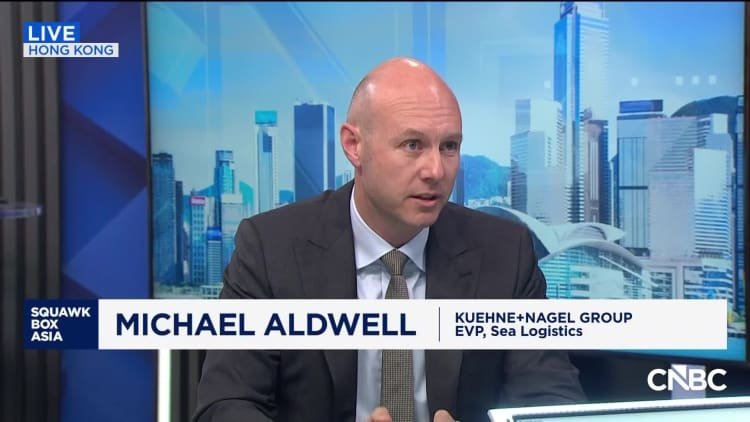
Chinese companies are increasingly taking greater control over overseas supply chains as they expand globally, said Michael Aldwell, executive vice president for sea logistics at Swiss shipping company Kuehne+Nagel.
“We see a rising amount of business in our industry that’s controlled, decided, shipped, and paid for here in China,” Aldwell told CNBC’s “Squawk Box Asia.” These sectors include electric vehicles, batteries and consumer electronics, he added.
“We basically see this trend where when the China-based supply chain management organization is more mature than the destination market, or where you’ve got rapid change in an industry, the Chinese companies are choosing to take control over that supply chain.”
Automation lowers costs
Cost is one of the main reasons European companies are increasing production in China, the EU Chamber survey found.
Relatively low labor costs in China have helped power its role as a global manufacturing hub. But as factories face labor shortages, many have embraced automation — quickly.
“The cost of labor, which might be lower anyway, is becoming irrelevant itself, because [of] automation,” said Denis Depoux, senior partner, global managing director at Roland Berger, a consulting firm that helped the EU Chamber assemble the survey.
“The difference in the level of automation [versus] two years ago is mind-boggling. You don’t see anybody anymore,” he said, referring to his visit this week to a privately-owned Chinese copper manufacturing company.
Depoux added that while automation can initially cost more than human labor, factories can ultimately produce products more quickly.
For example, Chinese electric vehicle maker Nio, which has expanded into Europe, said one of its factories in China operates with 941 robots that can work fully autonomously across multiple vehicle models simultaneously — without workers on the production floor. That setup allows the factory to operate around the clock.
It’s all part of a local manufacturing ecosystem with access to lower industrial energy prices and raw material costs, Roland Berger pointed out in a March report titled “China’s cost and speed advantage: A wake-up call for Western companies.”
The report added that quarterly negotiations with suppliers on price and selective state subsidies often help Chinese products reach global markets earlier and at far lower costs.
About three-fourths of EU companies in China said their production facilities in the country were more efficient than operations elsewhere, the chamber’s survey found.
“In most industries today, you have at least one Chinese competitor, or an international competitor, that are leveraging Chinese supply chains,” Eskelund said.
“So I think in many industries, if you are able to compete on price and quality, you simply need to become a part of Chinese supply chains,” he said. “It’s not necessarily because you want to onshore on [to] China.”
Choose CNBC as your preferred source on Google and never miss a moment from the most trusted name in business news.