What Chinese liquor maker Moutai’s slump says about the country’s economy

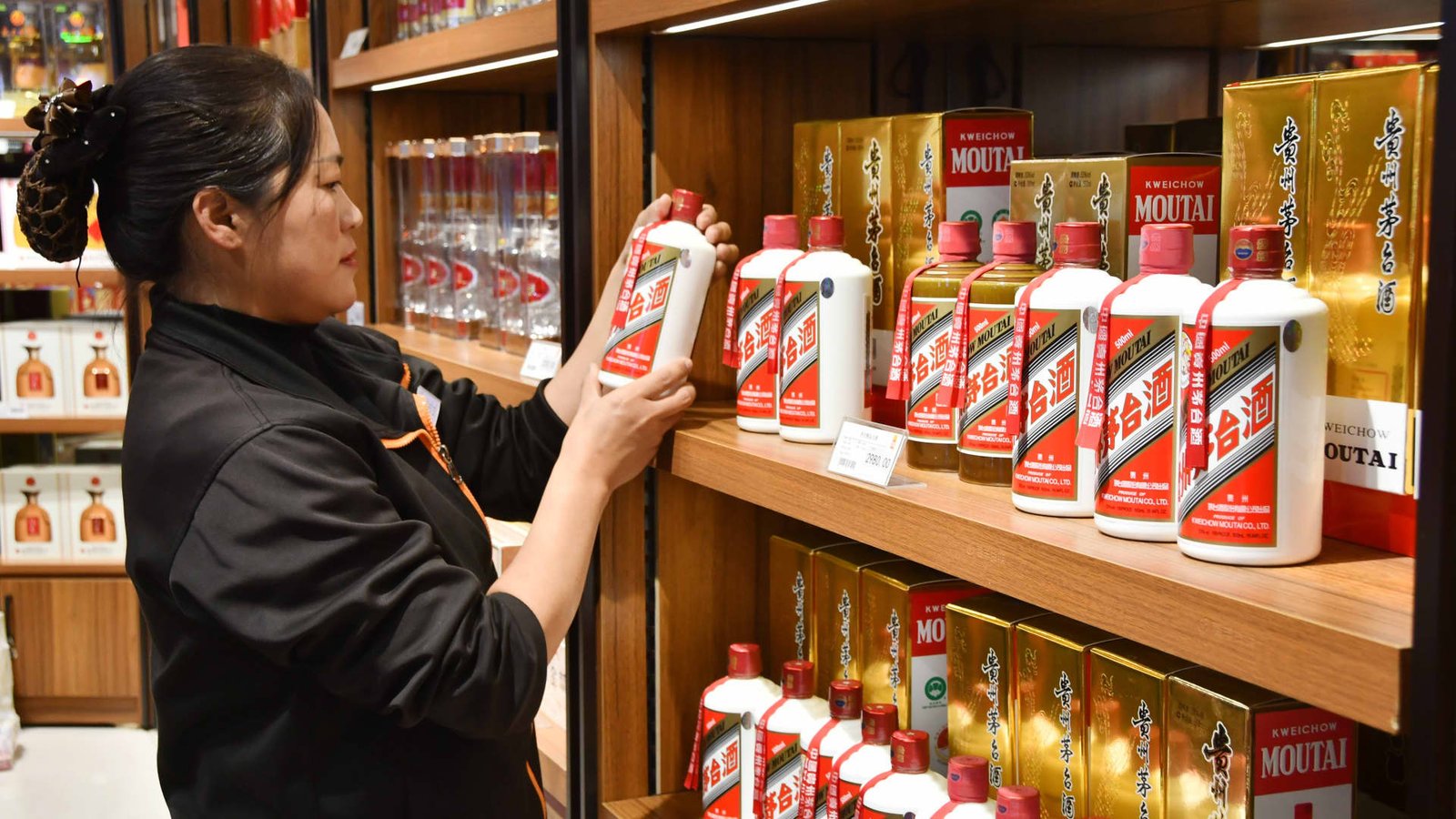
A staff member sorts Kweichow Moutai liquor at a supermarket in Yongnian district of Handan, North China’s Hebei province, Jan 9, 2025.
Cfoto | Future Publishing | Getty Images
BEIJING — Walk down most streets in China and you’ll find a liquor store advertising premium spirits brand Moutai, along with posters of resale prices by vintage year.
It’s a testament to how intertwined the red-and-white-labeled bottles have been with China’s economy in recent decades. The 53% alcohol content “baijiu” was long a staple at government and business dinners for toasts and sealing deals, so much so that Moutai’s stock became a market bellwether.
But the spirits company is now struggling, as China’s business world adapts to the tech-heavy artificial intelligence era.
Kweichow Moutai’s half-year report this month showed a rare drop in net profit, down by 1.95% to 44.5 billion yuan ($6.6 billion). It was the first decline for the first six months of a year since 2014, and only the second such drop based on data going back to 2002, according to Wind Information data.
The latest results followed a decline of 4.5% in net profit for all of 2025 — the first annual decline on record, data showed.
It’s all related to changes in the economic environment, said Ye Yuhua, fund manager at Ba Luo Fund. That’s according to a CNBC translation of Mandarin.
China’s economy in the second quarter expanded at its weakest pace since the fourth quarter of 2022, with urban fixed-asset investment, including real estate development and infrastructure projects, declining 5.7% in the first six months from a year earlier.
When the real estate sector thrived, there were naturally more scenarios involving premium baijiu consumption, Ye said. Now with the economic shift to high-end tech, he noted the people involved with this emerging industry aren’t as inclined to drink baijiu.
“It’s an irreversible trend,” he said. “Baijiu has become a saturated market.”
China’s anti-corruption crackdown has intensified in recent years, contributing to drag on retail sales. In 2020, Chinese authorities also tightened restrictions on real estate developers’ ability to borrow heavily for growth, clamping down on a construction-heavy sector that had come to determine a quarter of the economy.
Stock drop
Moutai was the largest listed company in mainland China by market capitalization from 2020 to 2023, according to Wind Information data.
Shares briefly fell Monday after the weekend release of its semi-annual financial report, driving its year-to-date losses to 5.7% as of Tuesday. The stock is has declined on an annual basis for four consecutive years.
The half-year report also showed China’s state funds Central Huijin and China Securities Finance, sometimes dubbed part of the “National Team,” were no longer among the 10 largest holders of Moutai stock.
Institutional investor sentiment likely troughed given the exit of Huijin and China Securities Finance from its top 10 shareholders in the second quarter, Citi sad in a…