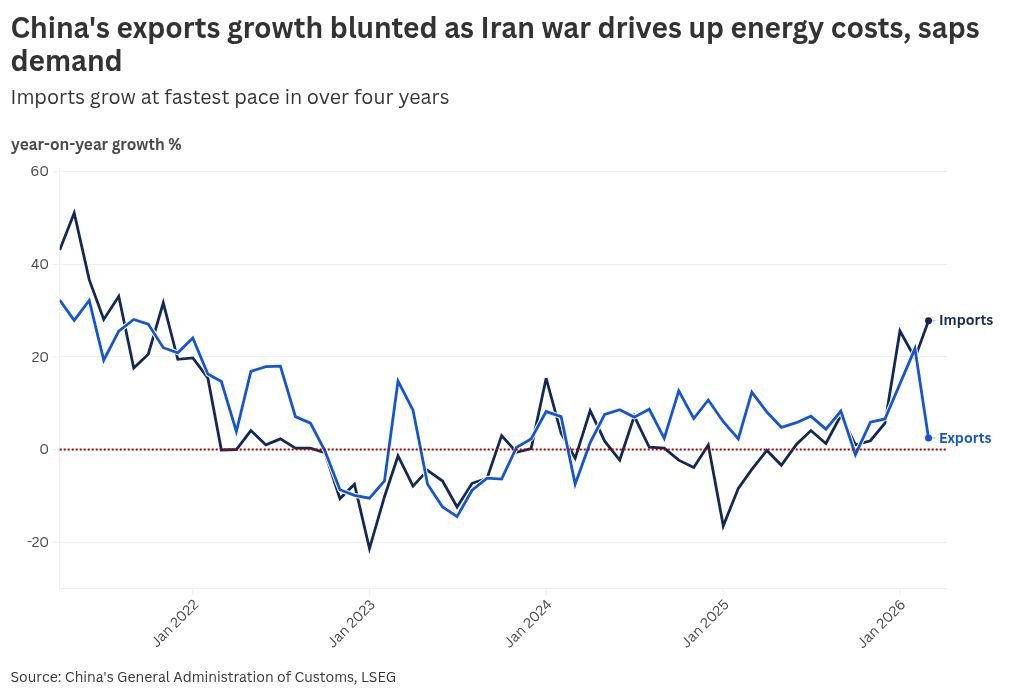
China exports miss estimates in March, imports post best growth in more than four years

China’s export growth slowed in March as manufacturers grappled with surging commodity and energy costs due to the Middle East conflict disrupting supplies, while imports logged the strongest growth in more than four years.
Exports grew at their slowest pace in six months at 2.5% in U.S. dollar terms last month from a year earlier, Chinese customs data showed Wednesday, missing Reuters-polled analysts’ median estimate for a 8.6% growth, and weakening from the combined 21.8% surge in the first two months of the year.
Shipments to the U.S., China’s largest trading partner by country, declined 26.5% year on year.
Imports surged 27.8% in March from a year ago, marking the strongest growth since November 2021, sharply beating expectations for a 11.2% growth, and quickening from 19.8% in the prior two months.
China releases combined trade data for January and February due to fluctuations around the Lunar New Year, the country’s biggest holiday, which follows the agrarian calendar.
The world’s second-largest economy has remained reliant on trade for its growth despite rising tensions with the U.S. and higher tariffs. Net exports accounted for about a third of China’s economy last year.
While Beijing’s strategic oil stockpiles, a diversified energy mix, and tight price controls have cushioned the blow from surging oil prices, the export-reliant economy remains vulnerable to a global economic downturn resulting from a prolonged closure of the Strait of Hormuz.
In a press briefing on Tuesday, Wang Jun, China’s customs vice minister, said that global oil prices have experienced “fierce fluctuation,” creating a “complex and severe” trade environment.
China’s crude imports fell in March from a year ago, down nearly 2.8% in terms of volume, and about 4.4% in U.S. dollar terms, according to a CNBC calculation of the official trade data. Liquefied natural gas imports declined 10.6% in terms of volume and 22% in value.
Meanwhile, the country’s rare earth imports more than tripled in value last month, and soybean imports grew a modest 20% by volume.
Higher commodity and energy prices stemming from the conflict have started feeding into Chinese manufacturers’ input costs, threatening to weigh on firms’ already thin margins. Factory-gate prices in the country rose by 0.5% in March, climbing for the first time in more than three years.
However, the consumer price index rose by a slower-than-expected 1% from a year ago, as domestic demand remained under pressure.
The country is due to report its first-quarter gross domestic product on Thursday. Analysts polled by Reuters estimate a 4.8% increase, compared to a 3-year low of 4.5% in the fourth quarter of 2025.
Choose CNBC as your preferred source on Google and never miss a moment from the most trusted name in business news.