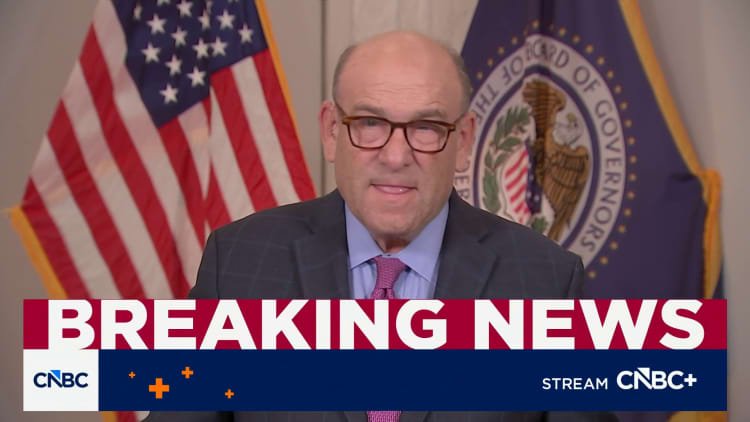
Fed votes to hold rates steady, notes 'uncertain' impacts from Iran war

WASHINGTON – The Federal Reserve on Wednesday voted to hold its key interest rate steady as policymakers navigate their way through higher-than-expected inflation readings, mixed signs on the labor market – and a war.
In a widely expected decision, the Federal Open Market Committee voted 11-1 to keep the benchmark federal funds rate anchored in a range between 3.5%-3.75%. The rate sets overnight funding costs for banks but influences a broad range of consumer and business borrowing.
The committee in its post-meeting statement made few changes to its view on the economy, with a slightly faster pace of growth and higher inflation projections for 2026.
Despite the elevated uncertainty, officials again signaled they still expect a few rate cuts ahead. The closely watched “dot plot,” which reflects individual members’ rate projections, pointed to one reduction this year and another in 2027, though the timing remains unclear.
Of the 19 FOMC participants, seven signaled they expected rates to stay unchanged this year, one more than the last update in December. While future years showed a fairly wide disbursement of forecasts, the median outlook is for an additional cut in 2027 before the funds rate steadies out around 3.1% for the long term.
War’s implications are ‘uncertain’
The statement did note the uncertainty associated over the war with Iran that started nearly three weeks ago. The fighting and its impact on the Strait of Hormuz has roiled the global oil market and threatened to keep inflation above the Fed’s 2% target.
“The implications of developments in the Middle East for the U.S. economy are uncertain,” the statement said.
During his news conference, Federal Reserve Chair Jerome Powell elaborated, saying it was “too soon to know” the impact of the war.
“Near term measures of inflation expectations have risen in recent weeks, likely reflecting the substantial rise in oil prices caused by the supply disruptions in the Middle East,” he said
Governor Stephen Miran again dissented, favoring a quarter percentage point cut amid rising concerns about the jobs climate. Governor Christopher Waller, who joined Miran in wanting a cut in January, voted this time to hold.
Before the conflict, markets had been pricing in two reductions this year, with a small chance of a third. But rising oil prices and a string of firm inflation readings — entailing data from before the energy shock — have pushed expectations down to at most one cut in 2026.
Faster economic growth seen
In updates to their economic projections, Fed officials see gross domestic product increasing at a 2.4% pace this year, a bit faster than in December. Growth is projected to progress at a solid 2.3% rate in 2027, up three-tenths of a percentage point from the previous outlook.
Officials also upped their inflation outlook for this year. They now expect the personal consumption expenditures price index to reflect a 2.7% inflation rate, both on headline and core. However, they see inflation falling back near the Fed’s 2% target in ensuing years as the impact of tariffs and the war fade. Policymakers continue to expect a 4.4% unemployment rate by year’s end, despite a string of weak payrolls readings.
The Fed’s decision to hold comes against a complicated political backdrop.
President Donald Trump continues to badger Powell and his colleagues to lower rates. Earlier this week, Trump criticized Powell for not calling a special meeting to ease, even with inflation running hot and the uncertainty of the war’s impact.
For his part, Powell presided over what could be his next-to-last meeting as head of the central bank. His term is set to end in May, and Trump has tapped former Fed Governor Kevin Warsh as the successor. Warsh has indicated a preference for lower rates, though he has not issued any recent public statements to indicate where his thinking is now.
Complicating the dynamic further is Trump’s own Justice Department.
U.S. Attorney Jeanine Pirro in Washington has subpoenaed Powell for evidence regarding the Fed’s multibillion-dollar headquarters renovation. Powell, though, has resisted the subpoena, and accused Trump of using it as a pretext to pressure the Fed into lowering rates. A judge sided with Powell on the issue, tossing the subpoenas and agreeing with the notion that the effort was simply to twist Powell’s arm to cut.
However, Pirro has vowed to appeal, and Sen. Thom Tillis, R-N.C., has in turn said he would block Warsh’s nomination in the Senate Banking Committee until the Powell matter is settled. Assuming the court battle continues past May, that would keep Powell in his seat until Warsh is confirmed.
Powell touched on this during the news conference, saying “I have no intention of leaving the board until the investigation is well and truly over, with transparency and finality.”
Once it wraps, Powell is undecided. “I have not made that decision yet, and I will make that decision based on what I think is best for the institution and for the people we serve.”
Powell’s term on the Board of Governors doesn’t expire until early 2028.
Correction: An earlier version of this story misspelled Sen. Thom Tillis’ name.
Choose CNBC as your preferred source on Google and never miss a moment from the most trusted name in business news.