Foreign car companies bet on technology to hang onto once-lucrative China auto market

BEIJING — Foreign automakers are finally catching up with their Chinese rivals on technology, as they battle a sales slump in the world’s largest car market.
U.S., Korean and German automakers rushed to announce a new lineup of models for China around the Beijing auto show that kicked off Friday.
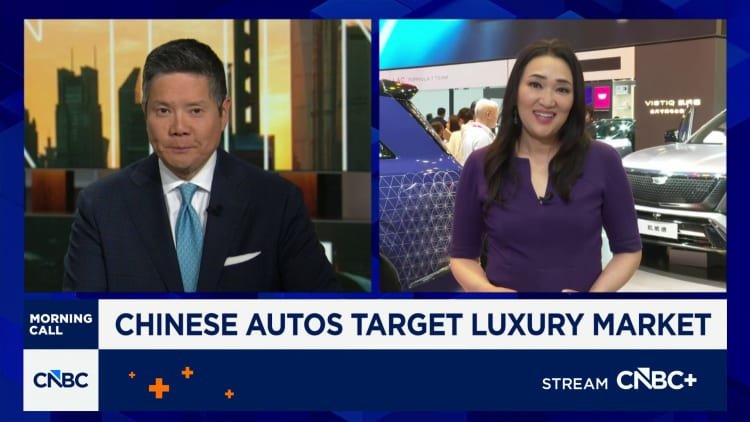
“We have plans to really build this brand and return [to] where we used to be in terms of volume and [market] share,” Will Stacy, vice president, Cadillac China at General Motors, told CNBC’s Eunice Yoon.
Cadillac on Wednesday announced its first car with driver-assist technology for China: a three-row “luxury” electric SUV, priced at 468,000 yuan ($68,000) and 508,800 yuan.
Called the VISTIQ, the vehicle uses advanced driver assist software that can handle highways and city roads, as well as automatic parking. The tech was co-developed with Chinese autonomous driving startup Momenta.
“We’ve been mostly an ICE [internal combustion engine] brand here in China, and with this vehicle that enables us to enter the game here in China,” Stacy said. He said sourcing locally in China allows Cadillac to compete effectively with its local rivals — cutting production time to 18 months — while the brand aims to attract customers with a promise of trust on safety.
Hyundai officially launched its all-electric IONIQ brand in China on Friday as the Korean automaker kicks off its most ambitious local expansion to date.
“China is where the future of mobility is being defined, and Hyundai intends to help define it, in China, for China, and ultimately, for the world,” José Muñoz, president and CEO of Hyundai Motor Company, said in a release.
Muñoz added in an interview with CNBC’s Eunice Yoon that as China has fallen from 17% to 4% of Hyundai’s total sales, the automaker had to “reimagine the strategy.”
Hyundai’s new IONIQ V also comes with advanced driver-assist co-developed with Momenta, and offers voice-control functions using an AI assistant that runs on a Qualcomm Snapdragon 8295 chipset.
Muñoz told CNBC that Hyundai could export the brand to Asia-Pacific, Australia and the Middle East if sales in China do well.
Hyundai’s China sales in March were about a third of what they were in the same month in 2019, before the pandemic. A number of other foreign carmakers have also seen sales drop over the same period. Figures compiled by CNBC suggest Nissan sales in China in March were down 47% on March 2019, while Cadillac fell 39%.
“I’m glad to see that these foreign brands are humble enough and recognize the value of the Chinese tech that they’re incorporating it,” said Stephen Dyer, partner and managing director and head of AlixPartners’ Asia automotive and industrials consulting practice.
He’s less optimistic that the foreign brands can win back significant market share in China, but said they have an opportunity to bring technology from China to their home markets.
“I think the technology … will disseminate throughout the world,” Dyer said. “I don’t think you can keep it locked up in the bottle of China. I think it’s already gone out.”
Cars with personality
German automaker Volkswagen, which is also embarking on its most ambitious China product campaign, announced Tuesday that it will begin rolling out AI-powered voice command in its cars in China starting in the second half of the year.
“The car should be like a companion,” Volkswagen China CTO Thomas Ulbrich said.
He said the company’s in-car AI agent would draw on tech from Tencent, Alibaba and Baidu, among others, to create a tool with “personality” that can anticipate a driver’s needs.
Volkswagen revealed four cars in Beijing on Tuesday, including the ID. UNYX 09, which the company said it co-developed with EV maker Xpeng in two years.
The German automaker has built a research and development center in Hefei where it can manage the entire production process.
Hyundai and its local state-owned partner BAIC had committed 8 billion yuan to a joint venture as of December 2024.
The venture, Beijing Hyundai, plans to introduce 20 new models in China over the next five years. The cars include the new IONIQ V, and another SUV in the first half of 2027 — with the goal of 500,000 sales annually.
China market leader BYD recorded sales of 688,993 in China in the first three months of 2026, though that marked a 30% drop on the same period in 2025. BYD sold 2.26 million battery-powered cars globally last year, exceeding Tesla‘s 1.64 million vehicle sales.
On average, 10 to 15 cars launch in China in the span of about a month, which means automakers “need to remain relevant and fresh” for customers who face many choices, Ivan Espinosa, president and CEO of Nissan, told CNBC’s Elaine Yu.
“The fact that we have established dealers with established experience, good relationships and good service for them, this is also starting to become more and more important,” Espinosa said.
Nissan plans to launch five new energy vehicles utilizing plug-in electric technology in the next 12 months.
The Japanese automaker has a joint venture with China’s Dongfeng, and integrated DeepSeek AI capabilities into its N7 electric sedan last year.

Subscribe now
— CNBC’s Matthew Chin contributed to this report
Choose CNBC as your preferred source on Google and never miss a moment from the most trusted name in business news.